Identity-free is key.
No phone numbers. No emails. No central accounts. Your privacy is not a setting — it's the architecture.
The Problem
Every messaging app you've been told to trust still requires a phone number. That number is a permanent link between your digital communications and your real-world identity. Even if your messages are encrypted, your identity is not.
The prvc.app difference: We remove the "who" from the "what." If we don't know who you are, there is nothing for us to share, sell, or lose.
| Feature | Your Current App | prvc.app |
|---|---|---|
| Identifier | Mandatory Phone Number | None |
| Social Graph | Uploads your contacts | No Contact Access |
| Metadata | Harvested & Linked | Zero Metadata |
| Account Recovery | Possible (Risk) | Impossible (Safe) |
| Data Sharing | Third-Party Ecosystem | Zero Sharing |
The Architecture
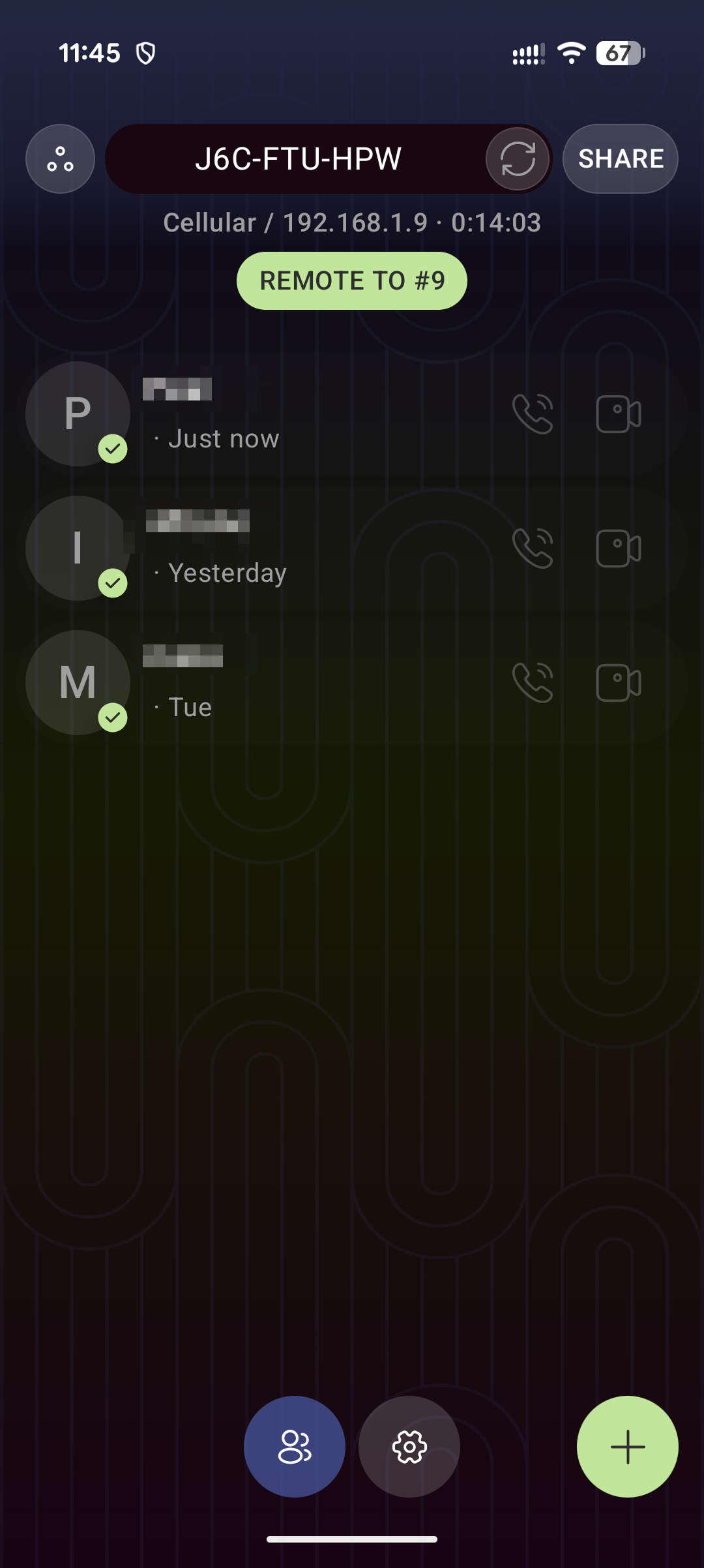
No registration. No account. Your identity is a random string tied only to your physical device. Delete the app — the identity vanishes forever.
Think of it like a handwritten address book kept only on your device. Only the people you explicitly add can reach you. If you lose your phone, there is no recovery — nothing is stored on any server.
Like a one-way mailbox: someone drops a message in for you, but only you hold the key to open it. Your message is then shattered into random shards, each encrypted differently, and hidden across haystacks of data distributed across servers around the world. Shards exist only in transit — once retrieved, they disappear. Time is working against any attacker: the window to act closes the moment the message is delivered.
A silent duress code. Entering your Panic PIN triggers a hardware-secured wipe of all local keys and data. It looks like a normal login failure — but everything is gone.
Our sharding model bypasses the "harvest now, decrypt later" threat. Even with unlimited computing power, an attacker cannot reassemble all the pieces in the correct order — and even if they could, they would still need the recipient's private key, which never leaves their device. Without the complete set of shards in the right sequence, there is nothing to solve.
How It Works
Complex security, made intuitive. Six familiar concepts that map exactly to how prvc.app protects you.
You step in, make your call, and walk away. No log of who you are, who you called, or what you said. prvc.app is the digital equivalent: connect, communicate, leave no trace.
Someone drops a message in for you, but only you hold the key to open it. No one else — including us — can retrieve what is inside.
Your contact list lives only on your device. No cloud copy, no backup server, no searchable directory. Only people you've personally invited can reach you.
Your message is never sent whole. It is shattered into random pieces, each encrypted differently. An attacker needs every shard — from multiple jurisdictions — to reconstruct anything at all.
Each shard is hidden inside vast haystacks of decoy data across servers worldwide. Finding one piece reveals nothing. The needle doesn't exist until all haystacks are searched simultaneously.
Even unlimited computing power cannot reassemble shards in the correct order. And even if it could, it would still need the recipient's private key — which never leaves their device. There is nothing to solve.
FAQ
Phone numbers are the "universal tracking ID" of the modern world. By removing them, we break the link between your physical identity and your digital communications.
Encryption protects your message content — not your identity. Every app that requires a phone number knows who you are, who you talk to, when, and for how long. That metadata is the product. In 2021, WhatsApp was fined €225M by the Irish Data Protection Commission specifically for failing to disclose how it shares this identity data. prvc.app is identity-free — there is no identity to harvest.
Connections are made via unique 64-character one-time invitation codes. You share these codes through a secure secondary channel or in person. There is no searchable directory — no one can find you unless you want them to.
Because we are identity-free, we have no "Account Recovery." If you lose your phone, your messages and identity are gone. This is a deliberate safety feature: if you can't recover it, neither can an adversary.
Yes. Messages are sent via peer-to-peer connections and evaporate within 24 hours (or less) from all nodes. No central server ever holds a complete file.
A PIN exists only in your mind. Under the Fifth Amendment, you cannot be legally compelled to reveal something you know — a memorized PIN requires a subpoena and formal legal process to contest. Biometrics are different: a court order can require you to unlock a device with your face or fingerprint, because providing it is a physical act, not testimony. prvc.app uses a PIN specifically because your legal protection is stronger. We prioritize your legal and physical safety over convenience.
Yes. You have total control over your connections and can permanently block any peer locally at any time. This severs the P2P link and wipes their shards from your device.
Privacy Policy · Last Updated March 18, 2026
prvc.app is designed so that collection is technically impossible.
No phone numbers, no emails, no names, no contacts.
No IDFA, no IP logging, no device fingerprints.
No third-party models (OpenAI, Gemini, etc.) touch your data. We don't analyze your messages.
No logins or profiles. Your presence is a random, ephemeral string of characters.
To delete all your data, delete the app. Because prvc.app is identity-free, there is no central account to close and nothing on our end to remove.
Terms of Service · Last Updated March 18, 2026
Support
During Apple App Store review, our inbox is monitored in real time. If you are an Apple reviewer, we will respond immediately.
To delete your data, delete the app. All local data is wiped immediately. There is no central account to close.